
The conversation nobody wants to start
You're thinking about bringing a lemon clitoral vibrator into your relationship. Maybe you've been using one solo and want to include your partner. Maybe they suggested it. Maybe you're both curious but neither of you knows how to actually make it happen without it feeling awkward or unsafe.
Here's what I know from years of working with couples: the toy itself is the easy part. The conversation is the hard part. And if you get the conversation right, everything else clicks into place.
Why this specific vulnerability matters
A clitoral vibrator is different from other toys. It's intimate. It's direct. It's yours. Inviting someone to watch or participate feels like opening a door to your body's most private mechanics. That's not melodrama. That's actually what's happening neurologically and emotionally.
What makes this especially complicated is that partners sometimes interpret toys as a sign of something wrong. "Does this mean I'm not enough?" Or the person introducing the toy worries their partner will judge them for wanting or needing it. Both of these conversations are worth having before the toy ever leaves the box.
The pre-toy conversation (do this first)
Start here, not in the bedroom. Here's what needs to happen:
Name the actual concern. "I want to try using a vibrator with you. I'm nervous because I don't want you to feel replaced or inadequate." That honesty does more work than any reassurance can.
Explain what you actually want. "I love what we do together. I also know my body responds differently to this kind of stimulation, and I want to experience that with you present." Those are two different things, and the distinction matters.
Ask what they're feeling. Not "Does this bother you?" but "What comes up for you when I say that?" The difference is that the second question lets them actually think instead of defaulting to "No, it's fine" (which is often a lie).
Set boundaries before anything happens. Not during sex. Before. "I want you to be able to touch me while I use it" or "I want to do this alone first while you're in the room" or "I'm not ready for you to use it on me yet." Those boundaries make the experience feel safer, not more restrictive.
Three different scenarios (and how to run each one)
Scenario 1: They want to watch
This is voyeurism, essentially, and it's common. Your partner finds arousal in watching your pleasure. There's nothing wrong with that, and honestly, it's often easier than partnered use because the roles are clear.
How to set it up: Ask if they want to be hands-on or hands-off. "I'm going to use the Lem while you watch. Do you want to touch me, or watch me touch myself?" That single question prevents the awkward moment where you're mid-orgasm and suddenly there's a hand in your space you didn't expect.
During: Use your normal technique. Don't perform. The hottest thing you can do is exactly what you'd do alone. Your partner is turned on by your genuine pleasure, not by you acting turned on.
After: Check in. "How was that for you?" Give them permission to say it wasn't their thing, or it was better than expected, or they want to try something different next time.
Scenario 2: You want them to use it on you
This requires more coordination because they're introducing the stimulation. Clitoral vibrators demand precision. A partner enthusiastically pressing a vibrator against the wrong angle is not the same as you controlling the angle yourself.
How to set it up: "I want you to use the Lem on me, but I need to guide where it goes." This is not you being difficult. This is you knowing your body. Use your hand over theirs if you need to. Say "up" or "left" or "stay there." Good partners want this input. Partners who resist it are showing you something important about how they handle boundaries.
During: Your job is to communicate. Start with patterns 1 or 2 on the Lem. Ask them to stay in one spot for 20-30 seconds before moving. Slow is almost always better than searching frantically around.
The refractory period thing: If you orgasm, your clitoris becomes hypersensitive fast. Some people need the vibration to stop immediately. Some want it to continue at a lower intensity. Figure out your pattern beforehand. "When I orgasm, I want you to keep it there but turn it down to pattern 1" is way less jarring than grabbing their hand mid-climax.
Scenario 3: You both want to use it together
This is trickier because a clitoral vibrator is designed for one body. You can't both stimulate the same area effectively with a single Lem. But you can create a rhythm together.
How to set it up: "I'll use it on myself while you're inside me" or "I'll use it while we're making out and you touch me everywhere else." The Lem complements partner sex. It doesn't replace it.
During: Communication is constant. "Faster" or "slower" or "I need a second." Partners who get frustrated with these requests are showing you they care more about the performance than the pleasure. That's data.
A note on positioning: If your partner is inside you, the Lem is your tool, not theirs. You control the speed and angle. Their job is to be present and responsive. If they want to control the vibrator while also being inside you, that requires a lot of coordination and honestly, the Lem wasn't designed for that level of multitasking.
What happens if it feels wrong
Your body might shut down. You might feel exposed. You might realize that your partner's presence actually kills your arousal, and that's okay. That information is useful.
If this happens, pause. Don't power through. "This isn't working for me right now" is a complete sentence. You don't owe anyone an orgasm, and forcing one while uncomfortable is the worst possible outcome.
There's a difference between "I'm nervous" (normal, solvable) and "I feel unsafe" (stop, talk, consider whether this relationship is actually safe). Check in with yourself on which one is happening.
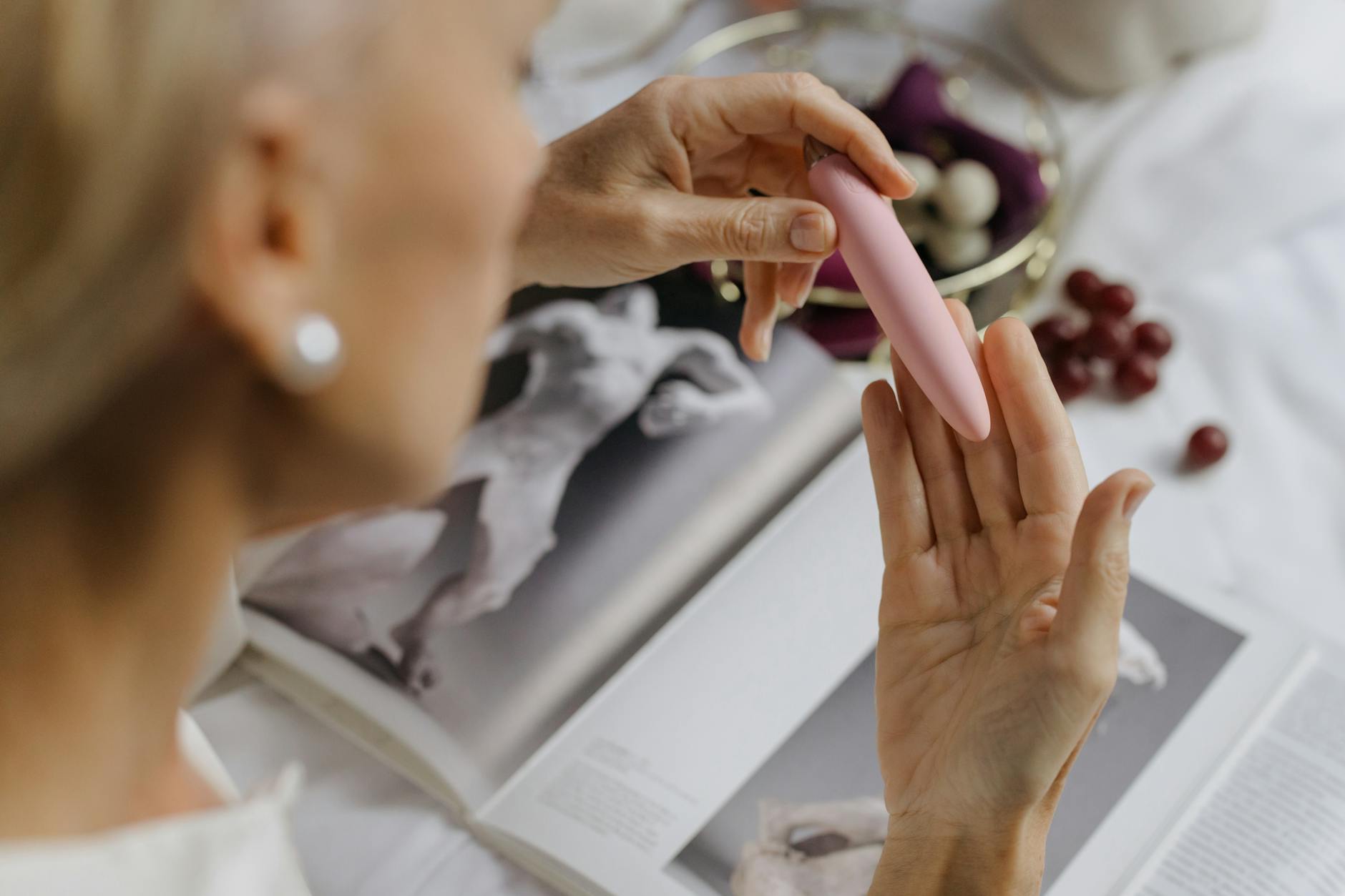
Photo by cottonbro studio on Pexels
The practical setup
Lube first. Water-based, always. It feels better, reduces friction, and makes everything less stressful. "I'm using lube because it feels better" is not a statement about your body. It's basic physics.
Wash the Lem beforehand. This is hygienic and it also signals that you've prepared. Your partner will notice and interpret that as "I'm taking this seriously and I want it to feel good."
Charge it fully. Nothing kills momentum like a dying vibrator. Full charge, every time.
Have an exit strategy. What happens if you want to stop? Not mid-orgasm. Just... if you decide this isn't working. "We can stop anytime" is not permission to use force later. It's a real agreement that you both honor.
Why this matters beyond the bedroom
Let's be real. If you can't talk about a vibrator with your partner, what else aren't you talking about? If they can't hear "I want this" without getting defensive, that's not a sex problem. That's a relationship problem, and the toy just made it visible.
Conversely, if your partner listens. If they ask questions. If they make space for your pleasure even when they don't fully understand it. That's a partner who's worth keeping around.
The lemon vibrator isn't magic. It's a tool. But it's a tool that reveals how safe you actually feel with someone. And that's worth paying attention to.
FAQ: Using a lemon vibrator with your partner
What if my partner is uncomfortable with vibrators in general?
Start by asking why. Is it jealousy? Is it religious or cultural belief? Is it a control issue? Those are different conversations. If it's about pleasure, you can say: "This isn't about replacing you. It's about my body responding to different kinds of stimulation." If it's about control, that's bigger than the toy, and it might be worth talking to a therapist about.
Can my partner use the Lem on themselves while I watch?
Absolutely. If your partner has a vulva, they can use it solo while you're present. If they don't, some partners enjoy using it on their partner and that's partnered play. The dynamic works both ways.
How do I ask my partner to use it on me without it feeling like I'm being demanding?
"I'd love if you'd use this on me sometime. I'll tell you exactly where and how" is straightforward and gives them an out if they're not into it. Let them say no without sulking. If they keep saying no, that's information.
What if my partner wants to film or share what we do with the vibrator?
Stop. That requires a completely separate conversation about consent, distribution, and privacy. You get to say no. "No recording, ever" is a valid boundary. Partners who push on that are showing you something important about how they value your safety.
Is there a "right" way to introduce toys into a long-term relationship?
There's no universal right way. Some couples do it early. Some do it after 10 years. Some never do. What matters is that you both actually want it, and that you're doing it because you want more pleasure together, not because one of you feels pressured. If either of those things isn't true, wait.
What if using a vibrator with my partner actually makes me feel more disconnected?
That's valid data. Some people find that toys create distance because they're thinking about mechanics instead of connection. If that's you, it doesn't mean you're broken. It might mean partnered toy use isn't your thing. You can still use the Lem solo, or try a different approach with your partner. Your pleasure doesn't have to look like anyone else's.
Bringing a lemon clitoral vibrator into your partnership is an act of trust. You're saying "Here's my body, here's what it needs, I want you to be part of that." The best partners show up for that. And if they don't, you've learned something important about what kind of partnership you actually have.