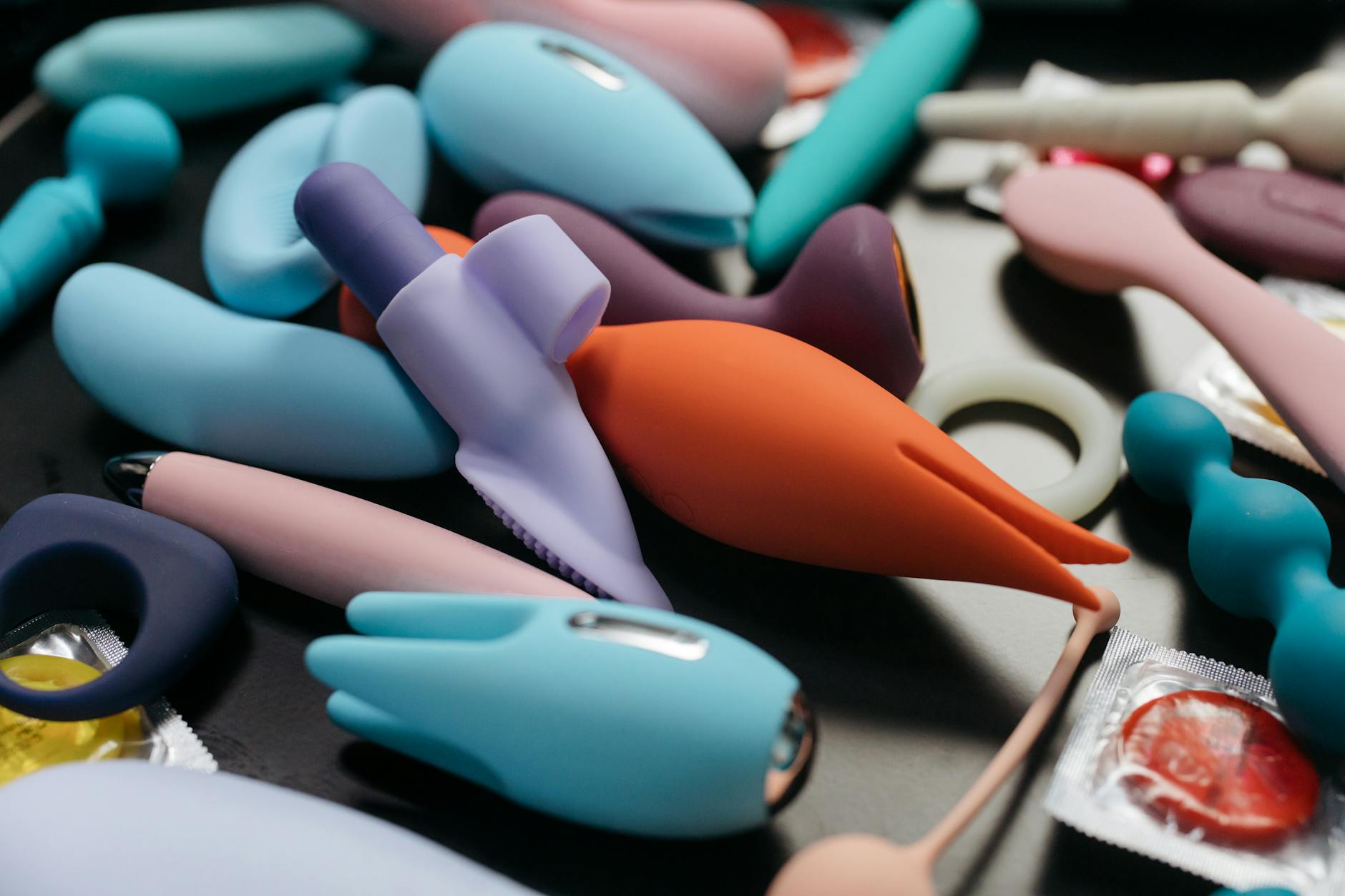
The overstimulation trap
Let's be honest: when you're being penetrated and someone brings a vibrator into the mix, the first instinct is usually panic. Not because it's bad. Because it's a lot. Your nervous system is already tracking sensation from inside, and now there's a lemon vibrator delivering suction to your clitoris on top of that. The urge to tense up, pull back, or shut it down is completely normal.
This is where most people either give up on the combo entirely or white-knuckle through it, gritting their teeth and pretending it's working. Neither is necessary.
Why dual stimulation feels different
Your clitoris and your vaginal canal aren't separate pleasure zones that neatly stack on top of each other. They share nerve pathways. When both are activated at once, your nervous system has to process input from two sources simultaneously. If the timing is out of sync, or if one sensation is significantly more intense than the other, it reads as confusing rather than pleasurable.
The clitoral complex extends internally, which means that penetration is already providing some clitoral stimulation. Add an external lemon vibrator, and you're not just doubling pleasure. You're layering two different types of sensation on top of each other. That requires coordination.
But here's the good news: when the timing, rhythm, and intensity are aligned, people often report that dual stimulation creates a completely different kind of orgasm than either alone. It's not just stronger. It's different in quality.
Start with penetration first
The sequence matters more than you'd think. The ideal entry point is to get comfortable with whichever form of penetration you're using (partner, toy, fingers), and let that rhythm establish itself completely. Build arousal from that alone for 5 to 10 minutes. Your body needs to adapt to the internal sensation before you layer anything else on top.
Once arousal is clearly building and the rhythm feels natural, introduce the lemon vibrator at its lowest setting. Not directly on the clitoris yet. Start on the pubic mound or the outer labia. The goal here is for your nervous system to register that there are now two things happening, without feeling invaded.
Many people find that having your partner or yourself introduce the vibrator while you're already aroused makes it feel like a natural addition, not an interruption. The pacing feels less jarring.
Intensity timing: the foundation rule
If penetration is happening at an intensity level of 5 out of 10, the lemon vibrator should start at 2 or 3. Not because lower is always better, but because your nervous system is already processing input. Adding a second stimulus that matches the intensity of the first creates sensory chaos.
Think of it this way: if penetration is slow and deep, the clitoral vibration should be gentler and more rhythmic. If penetration is faster and more vigorous, you can increase the vibrator's intensity. But they shouldn't peak at the same moment, or you'll hit that overwhelming wall.
Once you've had the lemon vibrator working for a few minutes at low intensity alongside penetration, you can experiment with gradually increasing it. The key word is gradually. A jump from pattern 1 to pattern 4 is a shock to the system. A slow creep is something your nervous system can integrate.
Positioning to manage sensation
Where the lemon vibrator sits makes a bigger difference than people expect. Direct clitoral contact during penetration can feel overpowering because you're not giving yourself an exit ramp if it becomes too much. Instead, position the vibrator so it's delivering sensation to the clitoral area without being centered directly on the clitoral glans itself.
This might mean angling it slightly upward, or positioning it over the clitoral hood rather than the tip. You're still getting strong suction stimulation, but it feels less like a direct assault and more like pleasure you can modulate.
For people with a partner doing the penetrating, communication about positioning is essential. Your partner can't see exactly where the vibrator is or how intense it feels. They're flying blind without you telling them. Simple directions like "slightly to the left" or "a little higher" give you back control while keeping the rhythm going.
The rhythm conversation
One of the biggest mistakes is assuming that the vibrator and the penetration should have the same rhythm. They often shouldn't. If your partner is thrusting, the lemon vibrator is usually better at a steady, continuous pattern that contrasts with the movement inside. This gives your nervous system two different things to track, which paradoxically feels less overwhelming than both moving in sync.
The exception is when you're very close to orgasm. At that point, matching rhythms can actually push you over the edge. Experiment with what works for you in the moment. Sometimes synchronizing for the final 30 seconds is exactly what you need.
Managing the pressure to perform
Here's something nobody talks about: when you're trying dual stimulation for the first time, there's often an implicit pressure that it should automatically feel amazing. When it feels confusing or overwhelming instead, people feel like they're doing it wrong.
You're not. You're learning your body's response to a new stimulus combination. That takes repetition. Most people need to try this 3 to 5 times before they understand what sensation they're actually looking for and what their body's genuine preferences are.
If at any point it feels like too much, slow everything down or stop entirely. You're not "supposed" to like dual stimulation. Plenty of people are perfectly happy with either penetration or external clitoral stimulation alone. There's no achievement unlocked for combining them.
Communication with a partner
If someone else is involved, the conversation needs to happen before, during, and after. Before: "I want to try using the vibrator while you're inside me, and I might need you to pause or slow down if it's too much." During: actual feedback about what's working. "Slower on that, please" or "Keep going with that rhythm, it's working." After: what you noticed. "That felt better when you paused between thrusts" or "I want to try starting the vibrator sooner next time."
A partner who's focused on their own experience can't also be reading your nervous system. You have to be the narrator. This is where <a href="/blog/how-to-use-lemon-vibrator-when-emotional-distance-blocks-physical-intimacy">emotional distance often blocks physical intimacy</a>. If you can't communicate directly about what your body needs, the mechanics of the toy don't matter.
When you're doing this solo
Solo dual stimulation is actually easier in some ways because you're the one controlling both sources. You can pause, adjust, sync, or desync entirely on your own timeline. The learning curve is usually shorter because there's no partner variable.
Start with a smaller dildo or the vibrator on a less intense pattern, and add the lemon vibrator once you've got some arousal built up. The advantage of doing this alone is that you can figure out your exact preferences without anyone else in the feedback loop. Then, if you bring a partner in later, you already know what you like.
The sensation peaks most people don't expect
After a few repetitions, something often shifts. Your nervous system stops trying to track two separate sensations and starts experiencing them as a unified sensation. That's when dual stimulation feels genuinely integrated rather than stacked. For many people, <a href="/blog/how-to-use-lemon-vibrator-for-better-clitoral-sensation-when-arousal-feels-numb">better clitoral sensation comes from understanding the specific patterns that work for your body</a>, and the vibrator is just the tool.
The orgasm that results from well-coordinated dual stimulation is often described as deeper or more full-body than what either sensation produces alone. But you have to get through the learning phase first, and that requires patience.
When the intensity peaks and won't subside
Some people find that once they're in the zone with dual stimulation, the intensity keeps escalating and they can't control it. If that's you, build in deliberate cool-down moments. Lower the vibrator's intensity by one pattern, or pause the penetration for 15 to 30 seconds. This gives your nervous system a beat to recalibrate without killing the whole moment.
You can also experiment with breathing. Slow, deep breathing actually calms your nervous system even while you're still being stimulated. It sounds simple, but it works.
Real talk on product choice
If you're considering getting a lemon vibrator specifically for dual stimulation with penetration, choose one where you can easily access different intensity patterns. The ability to start low and build gradually is what makes this work. A toy with just on/off is much harder to coordinate with penetration.
The suction-based design of a lemon clitoral vibrator is actually ideal for dual stimulation because it doesn't rely on direct friction. The stimulation is consistent without being aggressively pressing against sensitive tissue, which means there's more room to layer it on top of other sensations without everything feeling overwhelming.
FAQ
Is it normal for dual stimulation to feel overwhelming at first?
Completely normal. Your nervous system is processing input from two sources simultaneously. That's genuinely a lot. Most people need a few tries before their body learns to integrate these sensations. If it consistently feels bad rather than just intense, you might prefer one type of stimulation over the other, and that's perfectly valid.
Can I use a lemon vibrator during penetration with a partner if they don't have much experience?
Yes, but communicate clearly. Your partner needs to understand that you might ask them to slow down, pause, or change rhythm. If they're easily frustrated by that kind of feedback, this might not be the time to try it. Successful dual stimulation requires someone willing to follow your cues in real time.
What if the vibrator keeps slipping out of position during penetration?
Position matters, and so does grip. If you're holding it yourself, anchor your wrist or hand against your body so there's less movement. If your partner is holding it, they need to apply gentle pressure to keep it in place without pressing so hard that it's uncomfortable. A bit of lubricant can also help with grip.
Should I use more lubricant when I'm trying dual stimulation?
Often yes. Penetration plus external stimulation can change how much lubricant you're producing or how quickly you're using it up. Having extra available means you're not losing sensation midway through because things have dried out.
Can I orgasm faster with dual stimulation?
Some people do. Some people take longer because their nervous system is busy processing two inputs. Neither is better. Fast orgasms aren't superior to slower ones. What matters is whether the experience feels good to you.
How do I know if I'm doing this right?
You're doing it right if it feels good. That might take a few tries to figure out. If you're consistently frustrated, confused, or uncomfortable, you might prefer <a href="/blog/how-to-use-lemon-vibrator-when-you-want-pleasure-without-penetration">pleasure without penetration</a>, and that's a perfectly valid preference.